Recent Volumes
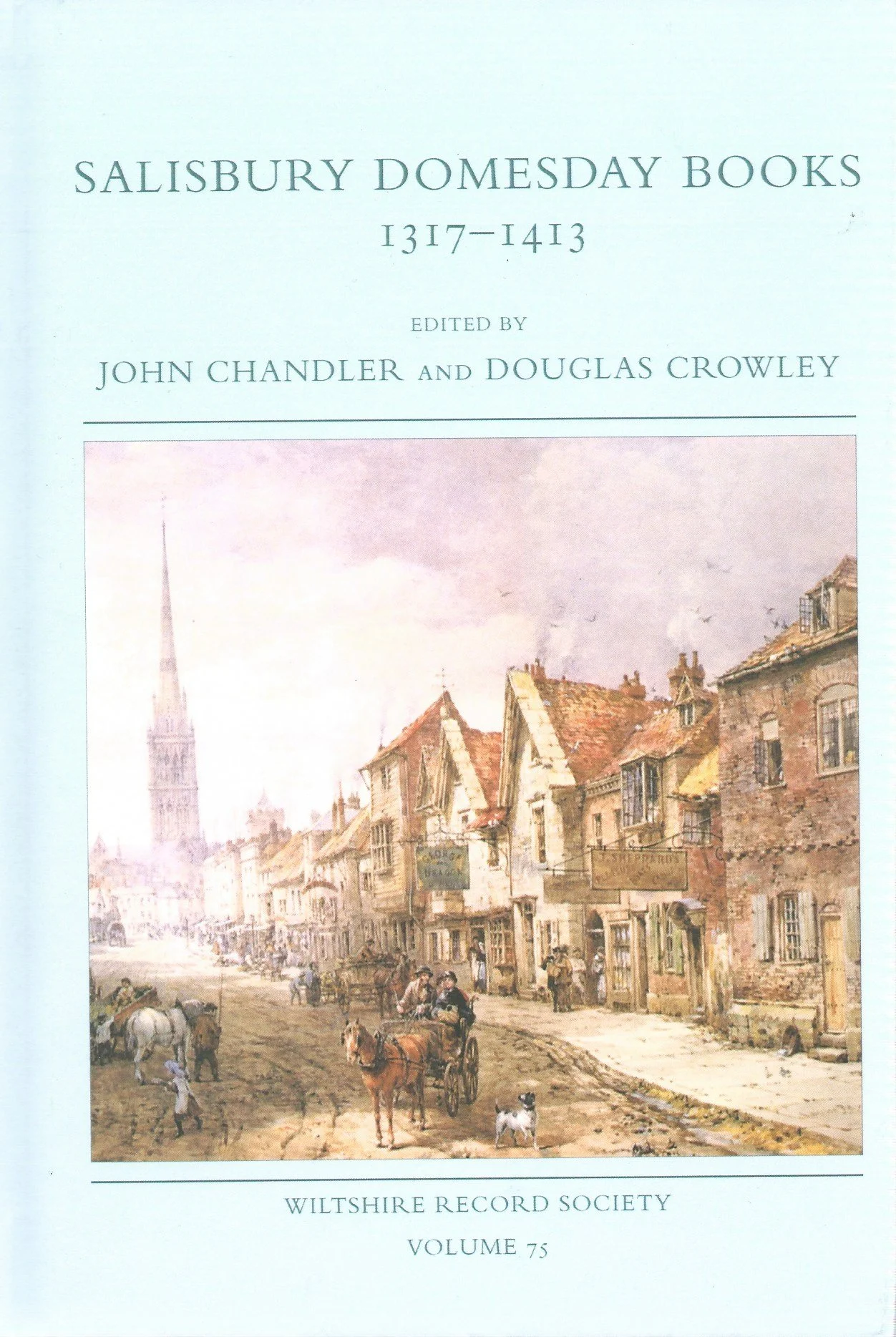
75 Salisbury Domesday Books 1317-1413, ed. John Chandler and Douglas Crowley, 2022
The surviving Salisbury Domesday Books form part of the Salisbury city archives, now deposited in the Wiltshire & Swindon Archives. Although the first, second and fourth books in the series do not survive, their loss is to some extent mitigated by a list prefixed to the sixth book, which summarises the contents of all the volumes between 1317 and 1422. The present volume is an edition of the third and fifth books, augmented by the summary list in the sixth. It covers the period 1317 (or earlier) up to 1413. A second volume will be an edition of the sixth and seventh books, and a third volume will attempt a synthesis of Salisbury’s medieval topography derived from these and other sources.
The Domesday Books consist of transcripts of charters, deeds, wills and other documents transacted in the bishop of Salisbury’s court relevant to the transfer of property in medieval Salisbury. They provided a record for the bishop and his bailiff that property transfers were conducted within the terms of the city’s charters, in which their existence was enshrined. But they also afforded protection for the citizens themselves, and so it was in the interest of the city corporation that they be maintained and preserved.
So large an accumulation of wills and deeds, extending over so long a period, yields invaluable information about Salisbury’s history, topography and citizens. Familial relationships are revealed by the parties to transactions and the beneficiaries of wills. Occupations may be given, and located to specific areas of the city. Notable topographical features and landmark buildings occur and may be described, along with the existence and nomenclature of streets and rows. The tenurial and land use history of individual locatable tenements may be traced over long periods. All in all the evidence to be extracted from the Domesday books offers a barometer of the city’s growth and prosperity, during a long period when many of its neighbours were in decline.
76 Returns to the Bishop of Salisbury’s Visitation Enquiry 1864, ed. Helen Taylor, 2023
In connection with his 1864 visitation, Walter Kerr Hamilton, Bishop of Salisbury, sent to each incumbent in his diocese a questionnaire asking under 52 heads about the state of worship, dissent, education, welfare, charitable giving and religious life generally in each parish. This edition comprises a full transcript of the returns to the visitation enquiry by 249 parish clergy in the Wiltshire portion of Salisbury diocese as then constituted (excluding the north Wiltshire deaneries of Cricklade and Malmesbury, which had been transferred to Gloucester and Bristol). The returns offer not only a parish-by-parish survey of aspects of the religious and social life of much of Wiltshire, but also reflect the character, attitudes and prejudices of Victorian clergy. The volume introduction describes episcopal visitation and enquiry, and analyses the returns. There is an index of persons and places.

77 Salisbury Domesday Books 1413–1478, ed. John Chandler and Douglas Crowley, 2024
This is the second of three volumes to be devoted to the Salisbury Domesday Books, which form part of the Salisbury city muniments, now deposited in the Wiltshire & Swindon Archives. Although three books, the first, second and fourth, have been lost, four survive. The third and fifth were edited as volume 75 in the Wiltshire Record Society series, published in 2022. This volume is an edition of the sixth and seventh books (excluding the summary list prefixed to the sixth book, which was edited in the first volume). It covers the period 1413 to 1478, and includes nine earlier documents. A third volume will attempt a synthesis of Salisbury's medieval topography derived from these and other sources. The Salisbury Domesday Books consist of transcripts of charters, deeds, wills and other documents transacted in the bishop of Salisbury's court relevant to the transfer of property in medieval Salisbury. Thir value for the student of Salisbury’s medieval topography and social history cannot be overestimated.

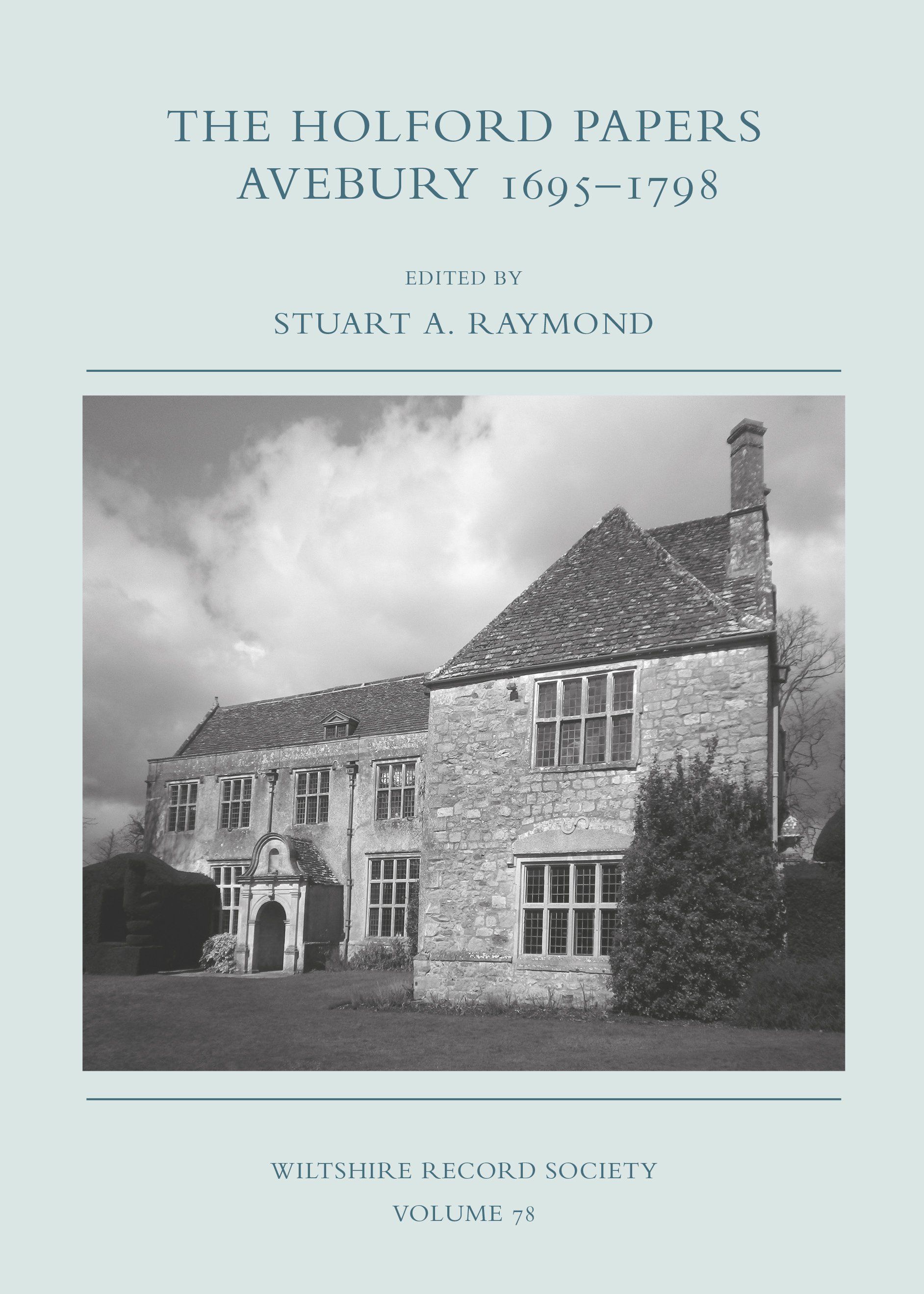
78 The Holford Papers, Avebury 1695–1798, ed. Stuart A. Raymond, 2025
Sir Richard Holford and his descendants were lords of the manor of Avebury for most of the eighteenth century, until the estate descended to Arthur Jones in 1767, and then to General Williamson in 1789. The Holford papers provide a great deal of information on the history of the manor, the parish, and the family. They include the journal of Sir Richard Holford, over two hundred letters written by or to Sir Richard and his heirs, various memoranda on manorial and family affairs, and the accounts of the manorial bailiff, Richard Hickley, which were sent to Anne Williamson when she was in Jamaica. Hickley’s monthly letters to his employer are also included. The topics covered are very varied: farm management and produce, tithe disputes between vicars and parishioners, the bankruptcy of the estate’s farmer, enclosure, the morals of vicars and parishioners, turnpikes and the state of the roads, building work at Avebury Manor, and leisure pursuits, are all covered. More minor matters include politics, the construction of the Kennet and Avon canal, the state of the poor, inn-keeping issues, service with the East India Company, and even advice on keeping the family’s archives. Stuart Raymond’s recently published Avebury without the Stones: A Social History c.1550-1800 (Hobnob Press, 2024) sets the Holford papers in their context, and provides a much more detailed introduction than is possible in this volume.